The Missing Financing Bridge Behind a Startup Round

A use-of-funds chart may show where capital is intended to go. It does not show whether the round can carry a company to its next decision-relevant proof point.

The amount of capital being raised is rarely hard to find. It usually appears near the end of a pitch deck, next to a use-of-funds chart and a stated period of runway.

The financial path behind that amount is harder to see.

Across the startup packages DueCap has screened so far, the proposed raise has consistently been easier to identify than the transition it was meant to fund. The materials might state the size of the round, divide it among product, hiring, sales, compliance, or operations, and sometimes add an estimate of how many months the capital should last. Yet the supplied information did not allow the full path to be reconstructed:

Current cash and obligations → post-close burn → milestone cost and timing → cash remaining at the milestone → next financing dependency

This is an early screening observation, not a claim about the startup market as a whole. Its importance lies elsewhere. A round is often presented as a sum of money and a set of spending categories, while the investment decision concerns a change in the state of the company.

A round is a claim about change

Suppose a company plans to spend 40% of a round on product development, 30% on commercial expansion, and the rest on hiring and operations. The allocation may be sensible. The percentages may add up perfectly. They still say little about whether the capital is sufficient.

The answer depends on where the company starts. A business with nine months of cash already on its balance sheet is in a different position from one that must close the round to meet next month’s payroll. Existing liabilities, restricted funds, receivables, debt service, transaction costs, and commitments made before closing all affect the amount of capital actually available for the plan.

The destination matters just as much. “Complete the product,” “expand sales,” and “reach the next stage” are budget themes, not financeable milestones. An investor needs to understand what will be observably different when the capital has been deployed. Depending on the business, that may be a production release with defined usage, a contracted revenue threshold, completion of a technical test, a regulatory submission, repeatable unit economics, or some other proof point that changes the company’s financing position.

Between the starting position and the milestone sits the part that is most often compressed: sequence. Hiring takes time. New employees begin consuming cash before they produce the expected output. Enterprise deployments can delay revenue while implementation costs continue. Hardware introduces deposits, inventory, certification, and working-capital demands. Regulatory or security work may depend on external reviews whose timing the company does not control.

The same use-of-funds chart can therefore describe very different financing risks.

Capital sufficiency is path-dependent

A stated runway figure does not resolve the problem unless its basis is visible. Runway calculated from current burn may ignore the hiring plan that the round is intended to finance. Gross burn can produce a different answer from net burn. A monthly average can hide a large payment due early in the period. Expected revenue can extend runway on paper even when collection timing is uncertain.

The timing of the milestone also matters. Reaching a target with enough cash to operate for another nine months is not equivalent to reaching it with enough cash for six weeks. In the second case, the company may need to begin raising again before it can demonstrate the result that was supposed to support the next round.

That changes more than liquidity. It can alter dilution, the company’s negotiating position, the choice of financing instrument, and the probability that management must accept a bridge on terms set by urgency rather than progress.

This is why a large round cannot be judged by size alone. A capital-intensive plan may justify an amount that initially looks high. A smaller software round may still be underfunded if enterprise implementation, customer concentration, or a long sales cycle delays the proof point. Capital sufficiency depends on the order in which costs, evidence, and financing needs arrive.

The missing bridge changes the interpretation of the round

When the financing bridge is absent, several statements that appear precise become difficult to interpret.

A use-of-funds allocation shows management’s intended categories of expenditure. It does not establish when the spending occurs, which costs are fixed, or which parts of the plan can be delayed.

A runway estimate states a period. Without current cash, burn definitions, the post-close operating plan, and timing assumptions, the period cannot be reproduced.

A milestone list describes ambition. Without cost, ownership, dependencies, acceptance criteria, and sequencing, it does not show which milestone the round can actually purchase.

Even the raise amount itself becomes ambiguous. It may represent the capital required for a defined plan, the amount management believes the market will support, or a broad target that will be adjusted after investor discussions. Those are different financing situations, particularly when the minimum viable close has not been separated from the full plan.

The absence of the bridge does not prove that the company is underfunded or that the round is poorly designed. It means the package does not yet support a conclusion about capital sufficiency.

Precision is not the standard

Early-stage companies operate with uncertainty. Revenue can arrive late, technical work can take longer than expected, and a new hire can change the cost structure before improving execution. A model that predicts every month with confidence would create more comfort than knowledge.

A useful financing bridge does not require that kind of precision. It requires visible assumptions and a small number of scenarios that preserve the economics of the plan.

The starting point should show current liquidity and unavoidable commitments. The operating path should reflect current burn and the expected post-close ramp rather than dividing the raise by a historical monthly average. The destination should be stated as evidence that an investor can recognize, not simply as completion of an internal task. Timing assumptions and external dependencies should be explicit. There should also be enough room between the milestone and cash exhaustion for the company to use the result, including time to raise again if another round is part of the plan.

A base case and a delay case will often reveal more than a detailed forecast built on one set of assumptions. If a modest delay forces an immediate bridge, the financing risk is part of the current round even if the base case shows adequate runway.

What screening can establish?

Initial screening cannot manufacture financial records or turn an uncertain plan into a reliable forecast. It can establish which relationships are supported by the submitted evidence and which remain assumptions.

That distinction matters because the individual pieces may each look plausible. The raise amount may fit the company’s stage. The allocation may appear reasonable. The runway may sound adequate. The milestones may be relevant. The problem emerges when the pieces cannot be connected into one financial transition.

Screening can test whether current cash and burn reconcile with the stated runway, whether hiring and operating plans fit within the allocation, whether the milestone has a measurable completion condition, and whether the company reaches it with enough capital to preserve financing options. When the records are missing, the result is not a speculative calculation. It is a defined evidence gap and a clearer view of what remains unresolved before the opportunity can be interpreted further.

This also improves the use of the founder conversation. Time need not be spent collecting unrelated facts or debating whether a percentage belongs in one category rather than another. The conversation can focus on the few assumptions that determine whether the round funds a complete transition or only part of one.

The financed transition

The economic object under review is the transition itself: the company’s current position, the path capital must finance, the proof point it is expected to produce, and the position the company will reach.

A clean use-of-funds chart may be part of that story, but it cannot carry the financing case on its own. The more consequential question is what new state of the company the capital is expected to buy, when that state can be verified, and how much financial room remains when it is reached.

Until those elements connect, the round remains an amount attached to a plan rather than a financing thesis that can be examined.
Method note: This essay draws on recurring patterns in DueCap’s early investment screening work. The observations are directional and are not presented as a market-wide statistical study. All underlying cases have been anonymized.

A faster result is not yet a benchmark

Why AI performance claims need a protocol, not just a before-and-after number.

In one recent screening, a startup presented a dramatic reduction in document-processing time. A workflow described as taking many hours could reportedly be completed in minutes. The improvement was large enough to attract attention. If reproducible, it could change the economics and usefulness of the product. But the investment package did not include the material needed to interpret the result: no dataset profile, test protocol, hardware configuration, model version, accuracy measures, failure rates, or human-review steps. The claim was specific. The evidence was not.

Speed answers only one part of the performance question

A processing time can show how quickly a system produced an output. It does not show whether the output was complete, accurate, consistent, or useful.

For an AI workflow, the practical result usually depends on several variables:

  • the type, length, language, structure, and quality of the input material;
  • the hardware and software environment;
  • the model and product version;
  • the accuracy threshold used to define completion;
  • the amount of human checking and correction required;
  • the frequency and severity of failures;
  • the user action the output is intended to support.

Without these elements, a faster time is an observation about one reported run. It is not yet a reliable description of product performance.

The baseline must represent the same task

A before-and-after comparison is only useful when both sides perform equivalent work.

The manual baseline may include classification, duplicate removal, verification, exception handling, annotation, and preparation of a final usable output. The automated result may measure only initial extraction.

If the two workflows stop at different points, the time comparison can be arithmetically correct and operationally misleading.

The screening therefore moved beyond asking how long each process took:

What exact task was completed in each workflow, to what quality standard, and at what point was the output considered ready for use?

Accuracy belongs inside the benchmark

Speed and accuracy are not separate claims when the product converts unstructured information into structured outputs.

A system can appear faster by extracting fewer fields, accepting more false matches, overlooking difficult inputs, or transferring unresolved work to the user.

The relevant measures depend on the product, but the benchmark may need to include:

  • precision and recall;
  • false-positive and false-negative rates;
  • duplicate-detection accuracy;
  • field-level completeness;
  • correction frequency;
  • failure and abstention rates;
  • performance across easy, median, and difficult inputs.

The fastest run is rarely the most informative result. The distribution of performance across representative inputs is more useful.

Human review can return the time that automation removed

An automated workflow may finish in minutes and still require hours of review.

That review is not necessarily a weakness. In high-consequence workflows, human approval may be essential. The problem arises when the benchmark reports machine-processing time but excludes the verification needed before the output can be trusted.

A complete comparison should show:

  • machine-processing time;
  • review time;
  • correction time;
  • exception-handling time;
  • total time to a usable output.

This turns an impressive technical result into a measure of workflow improvement.

The deployment environment can change the result

Performance depends on where and how the product runs.

A benchmark produced on high-end development hardware may not describe performance on a customer’s actual infrastructure. Local and offline deployment can introduce different constraints around memory, compute, model size, updates, storage, security controls, and concurrent usage.

The hardware envelope is therefore part of the product claim, not a technical footnote.

The evidence request should identify the processor, memory, accelerators, operating environment, model configuration, concurrency, and any external services used during the test.

Reproducibility changes the status of the claim

A benchmark becomes more decision-useful when another qualified person can reproduce it.

That does not always require disclosure of sensitive data or proprietary code. A controlled evidence package can still provide:

  1. a representative and appropriately redacted dataset profile;
  2. a written test protocol and completion criteria;
  3. hardware, software, and model versions;
  4. accuracy and failure measures;
  5. human-review requirements;
  6. results across repeated runs;
  7. logs or an authorized result summary;
  8. a live demonstration using agreed test inputs.

Each element narrows a different uncertainty. Together, they show whether the result is repeatable, transferable to the customer environment, and relevant to the intended workflow.

The benchmark should end with a user outcome

Even a reproducible technical benchmark does not establish commercial value by itself.

The final question is what changed for the user.

Did the system reduce the time to a decision? Did it allow the same team to process more work? Did it improve completeness, reduce errors, or make a previously impractical workflow possible? Was the result important enough for a customer to adopt, budget for, and continue using the product?

This connects technical performance to operating value and, eventually, to a commercial mechanism.

What the screening changed

The reported speed improvement remained worth investigating. The screening did not treat the absence of evidence as proof that the claim was false.

It changed the next step from repeating the headline number to requesting a reproducible benchmark package.

That distinction matters. A pitch deck can establish what a company claims. A benchmark protocol begins to establish what the product can repeatedly do, under which conditions, at what quality level, and with what practical effect.

The faster result was the reason to look closer.

The protocol was what could make it usable in an investment case.


See how DueCap structures an initial Investment Screening Brief

This note is based on an anonymized initial screening. Company, product, sector, geography, organizations, and identifying benchmark details have been removed or generalized. It does not describe an investment opportunity and does not constitute investment, technical, legal, or other professional advice.

What does an investor’s SPV check actually purchase?

Why an SPV needs a gross-to-net schedule before its economics can be understood.

An investor commits $100,000 through an SPV. How much of that amount reaches the company?The answer may be $100,000. It may also be less, depending on whether management fees, administration expenses, reserves, platform charges, and other costs are paid inside or outside the commitment.

The check amount alone does not resolve the question.

That issue appeared in our fictional screening of BeatQuanta AI. The investment memo described a $180,000 syndicate allocation, while the supplied SPV agreement introduced several additional layers of economics and control.

The screening package included enough information to identify the questions, but not enough to calculate an investor’s exact exposure.

One commitment can describe three different amounts

An SPV investment can involve three numbers that are often treated as if they were interchangeable:

  1. Gross contribution: the amount transferred by the investor.
  2. Net capital deployed: the portion used to purchase the underlying company security after applicable fees and expenses.
  3. Economic participation: the investor’s share of the SPV’s underlying ownership and eventual distributions.

Those amounts can be identical. They can also differ materially.

In the BeatQuanta AI example, the agreement described annual management fees of 3.5%, 3%, 2%, and 1% over four years, an aggregate schedule of 9.5%. It also listed an $8,800 SPV fee for the first four years and $1,400 after year four.

What remained unclear was the base used for each fee, when the amounts would be charged, how they would be allocated among members, and whether they would be deducted from investor contributions or paid separately.

The fee illustration changed the apparent exposure

To make the uncertainty visible, the screening brief included a conditional calculation.

If the $180,000 allocation represented the aggregate member capital base, and if the stated fees were deducted from that amount:

  • 9.5% in management fees would equal $17,100;
  • the separate SPV fee would add $8,800;
  • the combined amount would be $25,900;
  • that would represent 14.39% of the $180,000 contribution;
  • $154,100 would remain before any applicable platform fee, future expenses, or carry.

This was not a definitive reading of the transaction. The documents did not establish that the allocation and fee mechanics should be interpreted this way.

The calculation served a narrower purpose: it showed why the missing gross-to-net schedule could materially change the investment economics.

A percentage is incomplete without its base and timing

A fee schedule can look precise while leaving its economic effect unresolved.

A 3.5% management fee could be calculated on committed capital, contributed capital, invested capital, or another defined base. It might be charged once, annually, in advance, or as expenses occur. It could be deducted from the commitment or invoiced separately.

Each interpretation produces a different amount of capital invested in the company.

The screening therefore did not treat 9.5% as a complete answer. It treated it as the start of a reconciliation:

What is the fee base, when is each fee charged, how is it allocated, and does it reduce the investor’s capital deployed?

Carry is only one part of the return waterfall

The supplied agreement described a distribution waterfall in which capital would be returned first, followed by an 82% allocation to members and 18% to the manager.

That establishes the headline carry, but it does not fully describe the return economics.

The missing Master Agreement and Schedule A could affect fee definitions, expense allocations, tax treatment, reserves, distribution mechanics, and the relationship between the separate series and the broader vehicle.

Without the complete document set, the 18% figure could not be connected reliably to a representative investor’s eventual proceeds.

The ownership chain mattered as much as the fees

The investment memo described a Delaware C-Corporation called BeatQuanta AI. The SPV agreement identified the investment target as BEATQUANTA TECHNOLOGIES, INC.

The names may refer to the same entity, related entities, or a brand and its legal owner. The package did not establish the relationship.

That created a more fundamental question:

Which entity owns the product, IP, customer contracts, and revenue, and which entity and security will the SPV actually own?

A precise fee calculation cannot compensate for an unclear ownership chain.

Control and liquidity were part of the exposure

The agreement also gave the manager broad control and restricted transfers without consent.

These provisions may be common in SPV structures, but their practical effect depends on the complete governing documents. They influence what decisions members can make, how information is provided, whether interests can be transferred, how distributions are managed, and what happens when the underlying investment requires follow-on action.

The economic exposure therefore included more than the amount invested and the percentage of carry. It also included the investor’s rights, dependence on the manager, and limited liquidity.

The schedule needed before proceeding

In this case, the screening converted the available terms into a specific request for:

  1. the complete Master Agreement and Schedule A;
  2. the subscription agreement and investor questionnaire;
  3. confirmation of the legal issuer and underlying security;
  4. the fee base, timing, allocation method, and payment mechanics;
  5. an investor-specific gross-to-net schedule;
  6. the SPV’s ownership of the underlying security;
  7. the complete distribution waterfall and expected ongoing expenses;
  8. the manager-control, information, and transfer provisions.

The requested gross-to-net schedule should connect the transaction from beginning to end:

Gross investor contribution The amount transferred into the SPV
Less fees and expenses Management, administration, platform, legal, reserves, and other charges
Net capital deployed The amount used to purchase the company security
Underlying ownership The security, quantity, price, rights, and issuer held by the SPV
Investor participation The member’s share of the SPV after allocations and expenses
Distribution waterfall Return of capital, carry, remaining expenses, and net proceeds

The SPV may still offer entirely reasonable economics. The screening did not have enough information to determine that.

What it established was the gap between the headline allocation and the investor’s actual capital, ownership, rights, and return participation.

That gap deserved to be resolved before the check amount was treated as the investment amount.


View the complete fictional DueCap Investment Screening Brief

BeatQuanta AI is a fictional public example. All company names, people, entities, documents, dates, and figures in the sample were invented or altered. This material does not describe an investment opportunity and does not constitute investment, legal, or tax advice.

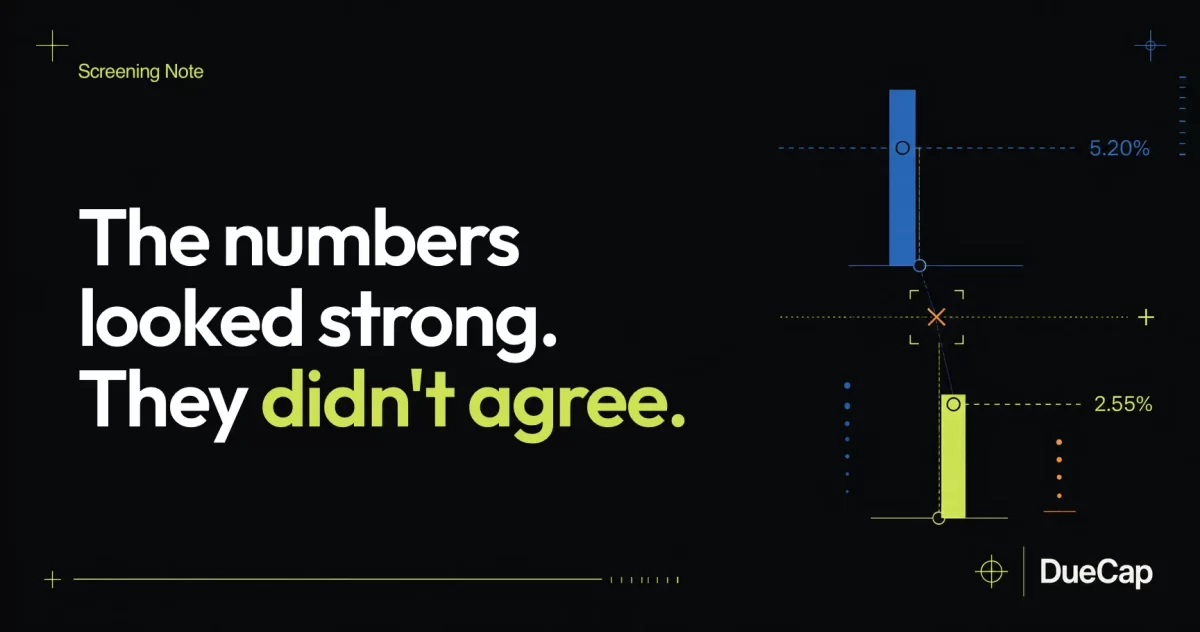
The numbers looked strong. They didn’t agree.

What a fictional AI startup case reveals about reconciling traction before the founder conversation.

What a fictional AI startup case reveals about reconciling traction before the founder conversation.A startup reports 642,800 users, 16,420 paid customers, $468,970 in monthly recurring revenue, and average monthly growth of 31% over six months.The same investment package reports a paid-ad cost of $0.86 per signup.It is easy to see why the opportunity deserves attention.But the package also reports a 5.20% signup-to-paid conversion rate and 28.90% monthly churn. Once the figures are read together, the apparent growth story becomes harder to interpret.

None of these numbers proves that the company is weak. The problem is that they do not yet explain how the business works.

That was the central issue in our fictional screening of BeatQuanta AI.

The conversion rate depended on an unstated denominator

The package reported:

  • 642,800 total users
  • 16,420 paid customers
  • 5.20% signup-to-paid conversion

Dividing paid customers by total users produces 2.55%, not 5.20%.

This does not necessarily mean the reported conversion rate is wrong. It may refer to a particular acquisition cohort, time period, geography, channel, or definition of an eligible signup.

But none of that was specified.

Without the denominator, cohort, and measurement period, the conversion rate cannot be connected reliably to the rest of the business.

The question for the company therefore becomes specific:

Which users are included in the 5.20% conversion calculation, over what period, and how does that cohort reconcile with the reported total and paid-user figures?

MRR did not fit the reported customer and pricing data

The company reported $468,970 in MRR and 16,420 paid customers.

That produces $28.56 in MRR per paid customer.

The investment memo also reported an average plan price of $22.10, while the highest listed monthly subscription was $27.99.

Several legitimate factors could explain the difference. Revenue might include annual subscriptions, affiliate income, enterprise accounts, additional purchases, or another category not visible in the pricing table. The definition of a paid customer may also differ from the definition of a paying account.

The screening package did not provide the revenue bridge needed to determine which explanation applied.

That leads to another focused request:

Reconcile MRR to paying customers, subscription plans, annual contracts, affiliate income, B2B revenue, refunds, credits, and any non-subscription revenue included in the figure.

Growth and churn pointed in opposite directions

BeatQuanta AI reported 19.60% MRR growth in April and average monthly growth of 31% over the preceding six months.

It also reported monthly churn of 28.90%.

Both figures can be accurate at the same time. Strong acquisition can produce rapid top-line growth while a large number of existing customers continue to leave.

That distinction matters because the same MRR chart could represent two very different businesses:

  • a growing base of retained customers with expanding recurring usage;
  • a high-throughput funnel that continually replaces departing customers.

Headline growth cannot distinguish between them.

The screening therefore moved from asking whether the company was growing to asking what was producing that growth:

How much monthly revenue comes from new, retained, expanded, reactivated, contracted, and churned customers?

A customer and MRR bridge, supported by retention cohorts, would make the mechanism visible.

A cheap signup was not yet a complete CAC

The reported paid-ad cost was $0.86 per signup.

If that figure is divided by the reported 5.20% conversion rate, the result is an illustrative paid CAC of approximately $16.54.

But that calculation is only meaningful if the signup cost and conversion rate describe the same channels, cohorts, geographies, attribution window, and period.

It also does not include unreported creative costs, agency fees, sales costs, payment fees, refunds, overhead, or founder-led acquisition activity.

A low cost per signup can be encouraging. Whether it creates economic value depends on what happens after the signup.

The more useful request is therefore:

Show acquisition cost, conversion, retention, refunds, and contribution margin by channel and customer cohort.

The ARR multiple could not resolve the underlying questions

The reported $72 million pre-money valuation represented approximately 12.8 times the company’s stated ARR.

That calculation provides context, but it does not establish whether the valuation is attractive or excessive.

The economic quality of ARR depends on factors the package did not provide:

  • retention;
  • gross margin;
  • compute and API costs;
  • revenue recognition;
  • monthly versus annual plan mix;
  • customer concentration;
  • acquisition payback;
  • durability of demand.

A revenue multiple becomes more informative after the revenue underneath it has been reconciled.

What the screening changed

The initial screening did not produce an investment verdict.

It converted a set of attractive but disconnected metrics into a targeted evidence request:

  1. Reconcile total users, paid customers, and conversion using consistent definitions.
  2. Define exactly what the reported churn rate measures.
  3. Connect MRR to customers, plans, and revenue categories.
  4. Provide customer and revenue retention cohorts.
  5. Show compute costs, gross margin, contribution margin, and fully loaded acquisition economics.
  6. Provide monthly customer and MRR bridges showing how the business moves from one period to the next.

The full review also identified questions beyond operating performance, including the legal identity of the investment target and missing SPV documents that could affect net capital deployed, investor rights, fees, and return participation.

This is why initial screening is not simply a review of whether individual metrics look strong.

Its purpose is to determine whether the claims, definitions, calculations, and documents combine into a coherent investment case, and to identify what remains unresolved before the investor spends the founder conversation rediscovering those gaps.

The reported traction in the BeatQuanta AI example supported continued attention. The available evidence did not yet support an underwriting conclusion.

The next step was not a yes or a no.

It was a better-defined set of questions.


View the complete fictional DueCap Investment Screening Brief

BeatQuanta AI is a fictional public example. All company names, people, entities, documents, dates, and figures in the sample were invented or altered. The material does not describe an investment opportunity and does not constitute investment advice.

AI Voice Agents for Debt-Collection Operations

DueCap completed an independent investment screening of a Pre-Seed vertical AI company building voice agents and workflow software for in-house debt-collection teams.

The company presented an MVP combining automated calling, messaging, segmentation, behavioral scoring, debt-management workflows, reporting, and integrations. Its materials reported $10,000 in current MRR, four customers, three pilots, and a $500,000 Pre-Seed raise.

The Screening Objective

The investor needed to determine whether the company’s reported customer traction, revenue, product readiness, operating outcomes, compliance posture, and financing plan were sufficiently supported to justify deeper review.

DueCap reviewed the company presentation, customer claims, product scope, revenue milestones, go-to-market plan, unit-economics assumptions, financing request, and stated runway.

What DueCap Identified

The company addressed a clear and costly operational problem, and the founder’s reported debt-collection experience provided a credible basis for the product thesis. A vertical platform combining AI calling with collection workflows could also create more value than a standalone voice-agent product.

However, the submitted materials did not establish the current commercial reality. Different parts of the deck referenced four customers plus three pilots, seven customers, and a nine-customer baseline without reconciling the dates or definitions. Reported MRR was not supported by contracts, invoices, receipts, or an account-level revenue schedule.

The review also identified inconsistencies between current revenue, future customer counts, and the stated $1 million ARR target. Product materials blended live capabilities with pilot, beta, and roadmap features, while key performance claims lacked underlying measurement records.

Because the product operates in debt collection, compliance was also a material screening issue. The package did not provide evidence covering calling and recording permissions, data handling, jurisdiction-specific controls, complaint procedures, or security practices. Financing terms, capitalization, cash position, burn, and a monthly use-of-funds plan were also absent.

What DueCap Delivered

  • Reconciled conflicting customer, revenue, and milestone claims.
  • Separated paid production, pilot, beta, and roadmap product capabilities.
  • Identified the evidence required to validate customer ROI and operating outcomes.
  • Flagged compliance, data-governance, and infrastructure-dependency questions.
  • Tested the relationship between the financing request, hiring plan, and stated runway.
  • Defined the minimum evidence package required for the founder conversation.

Screening Outcome

A focused founder conversation was warranted, but customer, revenue, compliance, product, and financing evidence was required before the opportunity could be interpreted further.

The screening shifted the investor’s attention from an attractive vertical-AI narrative toward account-level revenue quality, actual production usage, measurable customer outcomes, regulatory readiness, unit economics, and whether the proposed $500,000 round was sufficient to support the company’s operating plan.


This case is based on a completed DueCap engagement. Company identity and selected transaction details have been withheld or generalized to preserve confidentiality. Company claims were not independently verified by DueCap.

Offline AI and Geospatial Platform for Defense Operations

DueCap completed an independent investment screening of a development-stage defense technology company building an offline AI and geospatial platform designed to convert unstructured operational data into map-based intelligence.

The company presented the product as a tool for military units and command functions, with potential dual-use applications in infrastructure, logistics, city management, and digital twins. It was raising a $3.0 million Seed round, with 80% of the proposed capital allocated to research, development, and product work.

The Screening Objective

The investor needed to determine whether the company’s reported product readiness, field-testing activity, processing performance, security posture, commercial pathway, and financing plan were sufficiently supported to justify a founder conversation.

DueCap reviewed the company presentation, product workflow, claimed operational testing, competitive positioning, roadmap, market thesis, team, and use of funds.

What DueCap Identified

The company described a concrete and potentially valuable workflow: transforming fragmented documents, reports, sensor inputs, and other operational information into structured objects, annotations, reports, and an interactive map.

However, the most consequential claims were not supported by primary evidence. The package did not document the scope or results of reported field testing, the methodology behind the claimed reduction in processing time, or the exact boundary between a ready MVP and capabilities still scheduled through 2027 and 2028.

The review also found that security architecture, data rights, deployment controls, procurement readiness, pricing, customer evidence, financial position, capitalization, and financing terms were absent. The broad dual-use expansion thesis remained a set of possibilities rather than a demonstrated commercial plan.

What DueCap Delivered

  • Separated the current product from future roadmap capabilities.
  • Identified the evidence needed to validate field-testing and performance claims.
  • Flagged security, data-governance, and deployment-readiness gaps.
  • Tested the commercial model against the absence of buyers, contracts, pricing, and procurement evidence.
  • Reviewed the consistency of the use-of-funds allocation and roadmap.
  • Defined the minimum validation package required before the founder conversation.

Screening Outcome

Additional product, field-testing, security, commercial, and financing evidence was recommended before scheduling the founder conversation.

The screening shifted the investor’s attention from a broad defense-AI narrative toward the product’s demonstrated capabilities, reproducible performance, deployability in sensitive environments, procurement pathway, and the specific milestone the Seed round was expected to finance.


This case is based on a completed DueCap engagement. Company identity and selected transaction details have been withheld or generalized to preserve confidentiality. Company claims were not independently verified by DueCap.

In-Space Mobility and Orbital Logistics Company

DueCap completed an independent investment screening of a Seed-stage aerospace and defense company developing a high-thrust orbital vehicle for rapid maneuver, satellite defense, and in-space logistics.

The company was raising a $6.0 million Seed Extension through a SAFE with a reported $75.0 million post-money cap. Its materials also referenced a $35.5 million government prototype agreement, participation in a separate defense contract, several government research relationships, and approximately $1.4 billion in commercial letters of intent.

The Screening Objective

The investor needed to determine how much of the company’s technical, government, commercial, and financing narrative was supported by primary evidence and whether the current round could reach a proof point that materially reduced development risk.

DueCap reviewed the company narrative, reported development stage, government and commercial claims, proposed revenue model, financing terms, and the available SPV agreement.

What DueCap Identified

The company addressed a strategically important problem and presented a potentially differentiated propulsion and cryogenic-storage architecture. However, the submitted package did not establish that the core system had completed integrated propulsion, full-vehicle, launch, or orbital testing.

The review also found that the reported government awards and commercial demand could not be interpreted without the underlying agreements, funded amounts, statements of work, milestones, payment schedules, and conversion conditions. Headline contract values and non-binding letters of intent were not equivalent to attributable backlog or collectible revenue.

The projected revenue per vehicle was presented as a commercial thesis rather than demonstrated unit economics. Manufacturing cost, launch and refueling requirements, mission pricing, utilization, insurance, failure reserves, and cash collection were not supplied.

In addition, the SAFE, capitalization table, development budget, current cash position, runway, and financing plan through orbital demonstration were absent. The available SPV agreement disclosed fees, carry, control, and transfer restrictions, but the complete governing and subscription package was not included.

What DueCap Delivered

  • Separated demonstrated technical progress from planned capabilities and future missions.
  • Distinguished government engagement from funded and attributable backlog.
  • Tested the commercial claims against the evidence required for mission-level economics.
  • Identified the financing gap between the current round and orbital demonstration.
  • Reviewed the visible SPV fees, carry, control provisions, and missing documents.
  • Defined the technical, contractual, financial, and transaction evidence required for the next decision.

Screening Outcome

Additional technical, government-contract, capitalization, and transaction evidence was recommended before advancing the investment review.

The screening shifted the investor’s attention from strategic scale and headline contract values toward the company’s demonstrated technical stage, funded government work, achievable near-term milestones, capital requirements through flight validation, and the investor’s actual ownership and net exposure.


This case is based on a completed DueCap engagement. Company identity and selected transaction details have been withheld or generalized to preserve confidentiality. Company claims were not independently verified by DueCap.

Longevity and Health Optimization Platform

DueCap completed an independent investment screening of a Seed-stage longevity platform combining DEXA-based health measurements, personalized protocols, digital coaching, and recurring membership services.

The company reported approximately $5.7 million in annualized revenue, four operating locations, 1,000 active members, and more than 15,000 lifetime scans. It was raising a $2.0 million Seed round to expand into additional cities, add equipment, develop B2B integrations, and support technology, media, intellectual-property, and regulatory initiatives.

The Screening Objective

The investor needed to understand whether the company’s rapid growth, location economics, member retention, health-outcome claims, and expansion plan were supported by sufficient operating and financial evidence.

DueCap reviewed the company presentation, revenue claims, customer funnel, retention metrics, location model, unit economics, acquisition activity, use of funds, and proposed financing.

What DueCap Identified

The company had progressed beyond the concept stage and presented a distinctive physical-to-digital model. A paid health scan served both as an immediate service and as an acquisition channel into higher-value recurring coaching.

However, several central claims required reconciliation. The reported growth rate did not align with the monthly revenue figures visible in the deck, while the annualized revenue figure needed a clear bridge across locations, subscriptions, and the recently acquired digital business.

The review also found that the reported gross margin, customer acquisition economics, member retention, and rapid location payback depended heavily on definitions and cost-allocation policies that were not supplied. The proposed expansion to multiple markets was not supported by a complete site pipeline, opening schedule, cash budget, or location-level sensitivity analysis.

In addition, the company presented health outcomes and a growing longitudinal dataset, but the materials did not establish causal clinical effectiveness, data rights, regulatory positioning, or the controls required to support medical and performance-related claims.

What DueCap Delivered

  • Tested the consistency of reported revenue and growth metrics.
  • Separated activity, membership, and payment retention claims.
  • Reviewed location build costs, payback assumptions, and expansion exposure.
  • Identified the financial and operational effects of the recent acquisition.
  • Flagged unresolved clinical, regulatory, privacy, and data-governance questions.
  • Defined the minimum evidence package needed for the next investment decision.

Screening Outcome

Additional operating, financial, clinical, and transaction evidence was recommended before advancing the investment review.

The screening shifted the investor’s focus from headline growth toward the quality of revenue, fully loaded location economics, member retention, the validity of health-outcome claims, and whether the proposed Seed round was sufficient to finance the stated expansion plan.


This case is based on a completed DueCap engagement. Company identity and selected transaction details have been withheld or generalized to preserve confidentiality. Company claims were not independently verified by DueCap.

Independent Screening of a Series A AI Software Opportunity

DueCap completed an independent pre-investment screening of an AI-powered music-video creation platform raising a reported $10 million Series A round at an $80 million pre-money valuation.

The company was presented as a fast-growing subscription software business serving musicians, creators, and marketers. According to the submitted investment materials, the platform used an agent-based workflow and multiple generative AI models to produce beat-synchronized music videos, lyric videos, dance content, and short-form social media assets.

The opportunity showed enough reported traction to warrant continued attention. At the same time, the available package did not provide sufficient primary evidence to assess the durability of growth, the quality of recurring revenue, the company’s financial position, or the full economics of the proposed investment.

Engagement

DueCap was engaged to prepare the investor for the next screening decision before a founder conversation.

The review covered the investment memorandum, the available SPV operating agreement, reported operating and financial metrics, the legal identity of the investment target, and the economic terms visible in the supplied documents.

The purpose was not to issue an investment recommendation or perform full due diligence. It was to determine what could reasonably be concluded from the package, identify inconsistencies and material evidence gaps, and establish what should be requested before the investor committed further time or capital.

Opportunity Snapshot

Stage
Series A

Sector
Generative AI / Creator Software

Reported round size
$10 million

Reported pre-money valuation
$80 million

Reported MRR
Approximately $502,800

Reported ARR
Approximately $6.0 million

Reported monthly churn
30.66%

Materials reviewed
Third-party investment memorandum and SPV operating agreement

All company operating figures were treated as reported and unverified because the review package did not include company-prepared financial statements, billing exports, cohort schedules, a capitalization table, or financing documents.

What DueCap Found

Strong reported growth, but unresolved retention quality

The investment memorandum reported substantial user growth, paying customers, recurring revenue, and rapid ARR expansion. However, the same materials also reported monthly churn of 30.66% without defining the calculation or providing customer and revenue cohorts.

This created a central screening question: whether the reported growth reflected durable recurring adoption or a high-volume acquisition funnel continually replacing departing customers. Without cohort retention, gross and net revenue retention, plan mix, cancellation data, and reactivation treatment, the quality of the reported ARR could not be assessed.

Core operating metrics did not reconcile

Several headline metrics did not align on a first-pass arithmetic review.

The reported 17,650 paying customers represented approximately 2.61% of the reported 677,499 users, rather than the stated 5.56% conversion rate. Reported MRR divided by paying customers produced approximately $28.49 per customer, above both the stated average plan price and the highest listed monthly plan. The annual subscription discounts also appeared to be approximately 30%, rather than the stated 50%.

These inconsistencies did not establish that the metrics were incorrect, but they showed that definitions, cohorts, revenue composition, and source schedules were needed before the numbers could be relied upon.

Gross margin and compute economics were not visible

The platform appeared to rely on several external video-generation models while also identifying compute optimization and API scaling as uses of the new capital.

Despite this cost profile, the materials contained no company-prepared gross-margin data, compute or API expenses, vendor invoices, contribution margin, refund economics, or generation-level unit costs.

As a result, DueCap could not determine whether increasing product usage strengthened the economics of the business or increased its capital requirements.

The legal identity of the investment target required confirmation

The investment memorandum described the business using its brand name and referred to a Delaware corporation. The SPV agreement, however, identified a differently named corporation as the investment target.

The relationship between the brand, the operating company, and the named legal entity was not documented in the submitted package. This made it necessary to confirm which entity owned the product, intellectual property, customer contracts, data, and revenue, and which security the SPV intended to purchase.

The SPV package was incomplete

The supplied SPV agreement referenced additional governing documents that were not included in the review.

The visible terms included a multi-year management-fee schedule, a separate SPV fee, 20% carried interest, manager control provisions, indemnification language, and transfer restrictions. Without the complete agreement set and an investor-specific gross-to-net schedule, the actual amount of investor capital reaching the underlying company could not be determined conclusively.

What DueCap Delivered

DueCap prepared a structured Investment Screening Brief that included:

  • an executive screening outcome;
  • an independent summary of the opportunity;
  • financial consistency checks;
  • review of the visible round and SPV economics;
  • assessment of key business and financial signals;
  • identification of legal, operational, and transaction risks;
  • a prioritized evidence request;
  • and a set of questions for the next investor conversation.

The work converted a promotional investment package into a decision-oriented screening document focused on evidence, unresolved assumptions, and the investor’s next practical step.

Screening Outcome

Request targeted evidence before scheduling the founder conversation

DueCap concluded that the reported traction supported continued investor attention, but the package was not sufficient to validate operating performance, retention quality, unit economics, financial position, legal identity, capitalization, or complete SPV terms.

The recommended next step was therefore not to reject the opportunity and not to proceed directly to an investment decision. It was to request a defined evidence package first.

The priority request covered company-prepared financial statements, monthly revenue and customer schedules, retention cohorts, compute and gross-margin economics, cash and runway, current and pro forma capitalization, legal-entity confirmation, financing documents, and the complete SPV agreement set.

Why This Screening Was Valuable

The submitted materials presented an attractive headline narrative: rapid AI adoption, strong reported recurring-revenue growth, a large creator market, and a significant Series A financing.

DueCap’s screening showed that the investment decision depended on a different set of questions. The critical issues were not the size of the reported user base or the speed of ARR growth alone, but whether customers remained, whether revenue carried attractive margins, whether reported metrics used consistent definitions, whether the correct legal entity held the assets, and how much investor capital would actually reach the underlying company.

By identifying those issues before the founder conversation, the investor could enter the next stage with a focused evidence request rather than relying on the narrative of the investment memorandum.


Confidentiality notice

This case is based on a completed DueCap engagement. The company identity and selected transaction details may be withheld or generalized to protect confidential information. Reported company figures were not independently verified by DueCap.

AI-Powered Music Video Creation Platform

DueCap completed an independent investment screening of a Series A AI software company developing a platform that transforms music links or uploaded audio into synchronized music, dance, lyric, and social videos.

The company reported rapid user and revenue growth, including approximately $469,000 in monthly recurring revenue, more than 16,000 paying customers, and a proposed $9.0 million financing round at a $72.0 million pre-money valuation.

The Screening Objective

The investor needed to determine whether the reported growth, retention, unit economics, legal structure, and transaction terms were sufficiently supported to justify advancing the opportunity.

DueCap reviewed the investment memo, reported operating metrics, pricing, growth claims, proposed use of funds, and the available SPV operating agreement.

What DueCap Identified

The company presented a compelling product proposition in a fast-growing category and reported meaningful user adoption. However, several of the core operating figures did not reconcile when tested against one another.

Reported customer conversion, average plan pricing, paid-customer count, and monthly recurring revenue appeared inconsistent without additional definitions. At the same time, the reported 28.90% monthly churn raised a fundamental question about whether rapid customer acquisition was masking weak retention and repeat value.

The review also found that gross margin, compute costs, cash position, burn rate, runway, capitalization, and detailed use of funds were absent. In addition, the legal identity named in the investment memo differed from the entity referenced in the SPV agreement, while the available transaction documents did not include the complete governing package.

What DueCap Delivered

  • Tested the consistency of the reported operating and revenue metrics.
  • Identified retention and gross-margin evidence as central to the investment case.
  • Reviewed the relationship between the reported valuation and unverified ARR.
  • Flagged unresolved legal-entity and ownership questions.
  • Assessed the visible SPV fees, carry, control provisions, and missing documents.
  • Defined the minimum evidence package required for the next decision.

Screening Outcome

Targeted operating, financial, legal, and transaction information was recommended before scheduling the founder conversation.

The screening shifted the investor’s attention from headline growth toward the quality and durability of revenue, the economics of AI video generation, the identity of the entity receiving the investment, and the investor’s actual net exposure through the SPV.