

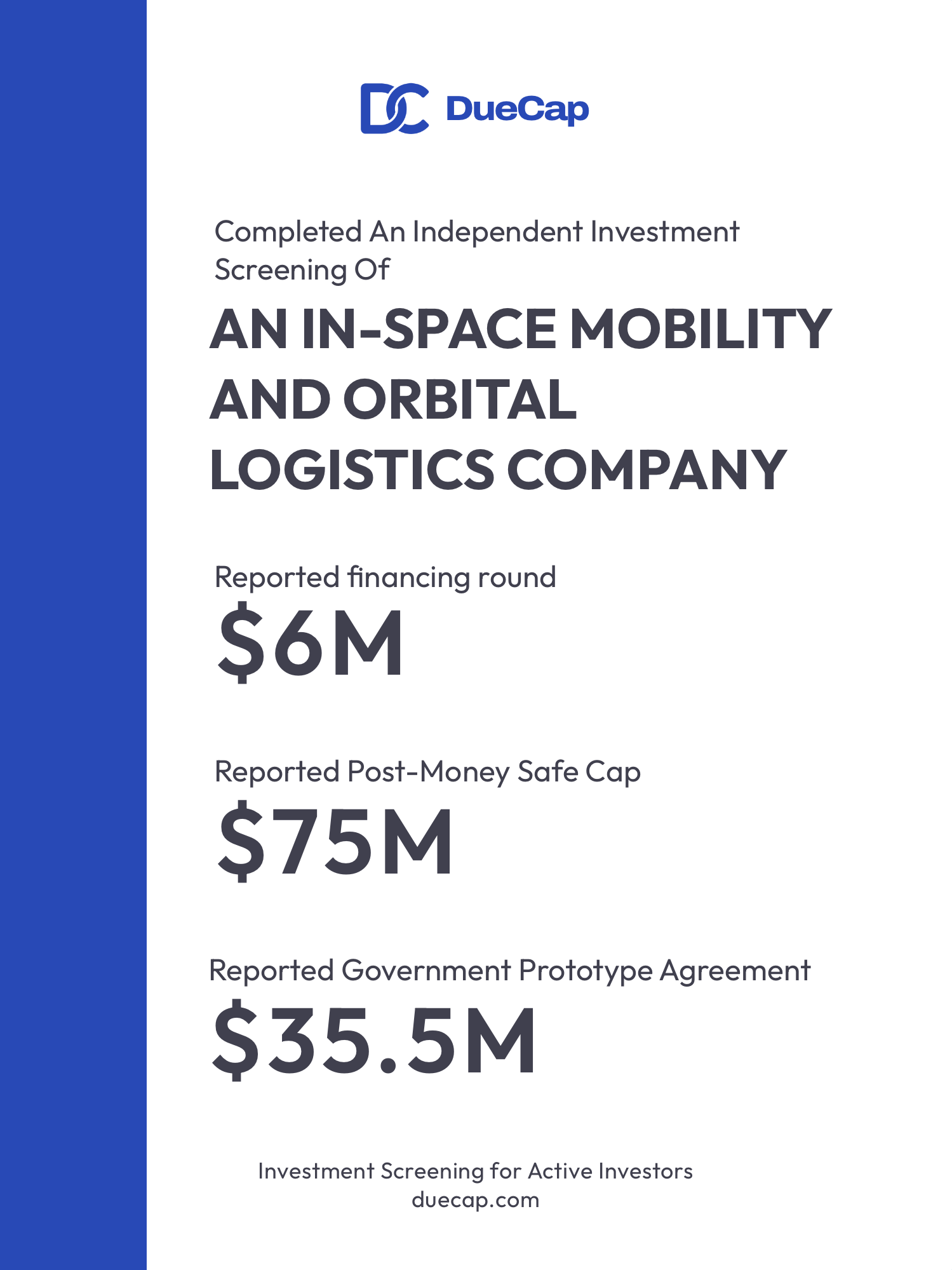
DueCap completed an independent investment screening of a Seed-stage aerospace and defense company developing a high-thrust orbital vehicle for rapid maneuver, satellite defense, and in-space logistics.
The company was raising a $6.0 million Seed Extension through a SAFE with a reported $75.0 million post-money cap. Its materials also referenced a $35.5 million government prototype agreement, participation in a separate defense contract, several government research relationships, and approximately $1.4 billion in commercial letters of intent.
The Screening Objective
The investor needed to determine how much of the company’s technical, government, commercial, and financing narrative was supported by primary evidence and whether the current round could reach a proof point that materially reduced development risk.
DueCap reviewed the company narrative, reported development stage, government and commercial claims, proposed revenue model, financing terms, and the available SPV agreement.
What DueCap Identified
The company addressed a strategically important problem and presented a potentially differentiated propulsion and cryogenic-storage architecture. However, the submitted package did not establish that the core system had completed integrated propulsion, full-vehicle, launch, or orbital testing.
The review also found that the reported government awards and commercial demand could not be interpreted without the underlying agreements, funded amounts, statements of work, milestones, payment schedules, and conversion conditions. Headline contract values and non-binding letters of intent were not equivalent to attributable backlog or collectible revenue.
The projected revenue per vehicle was presented as a commercial thesis rather than demonstrated unit economics. Manufacturing cost, launch and refueling requirements, mission pricing, utilization, insurance, failure reserves, and cash collection were not supplied.
In addition, the SAFE, capitalization table, development budget, current cash position, runway, and financing plan through orbital demonstration were absent. The available SPV agreement disclosed fees, carry, control, and transfer restrictions, but the complete governing and subscription package was not included.
What DueCap Delivered
- Separated demonstrated technical progress from planned capabilities and future missions.
- Distinguished government engagement from funded and attributable backlog.
- Tested the commercial claims against the evidence required for mission-level economics.
- Identified the financing gap between the current round and orbital demonstration.
- Reviewed the visible SPV fees, carry, control provisions, and missing documents.
- Defined the technical, contractual, financial, and transaction evidence required for the next decision.
Screening Outcome
Additional technical, government-contract, capitalization, and transaction evidence was recommended before advancing the investment review.
The screening shifted the investor’s attention from strategic scale and headline contract values toward the company’s demonstrated technical stage, funded government work, achievable near-term milestones, capital requirements through flight validation, and the investor’s actual ownership and net exposure.
This case is based on a completed DueCap engagement. Company identity and selected transaction details have been withheld or generalized to preserve confidentiality. Company claims were not independently verified by DueCap.