AI-Powered Music Video Creation Platform

DueCap completed an independent investment screening of a Series A AI software company developing a platform that transforms music links or uploaded audio into synchronized music, dance, lyric, and social videos.

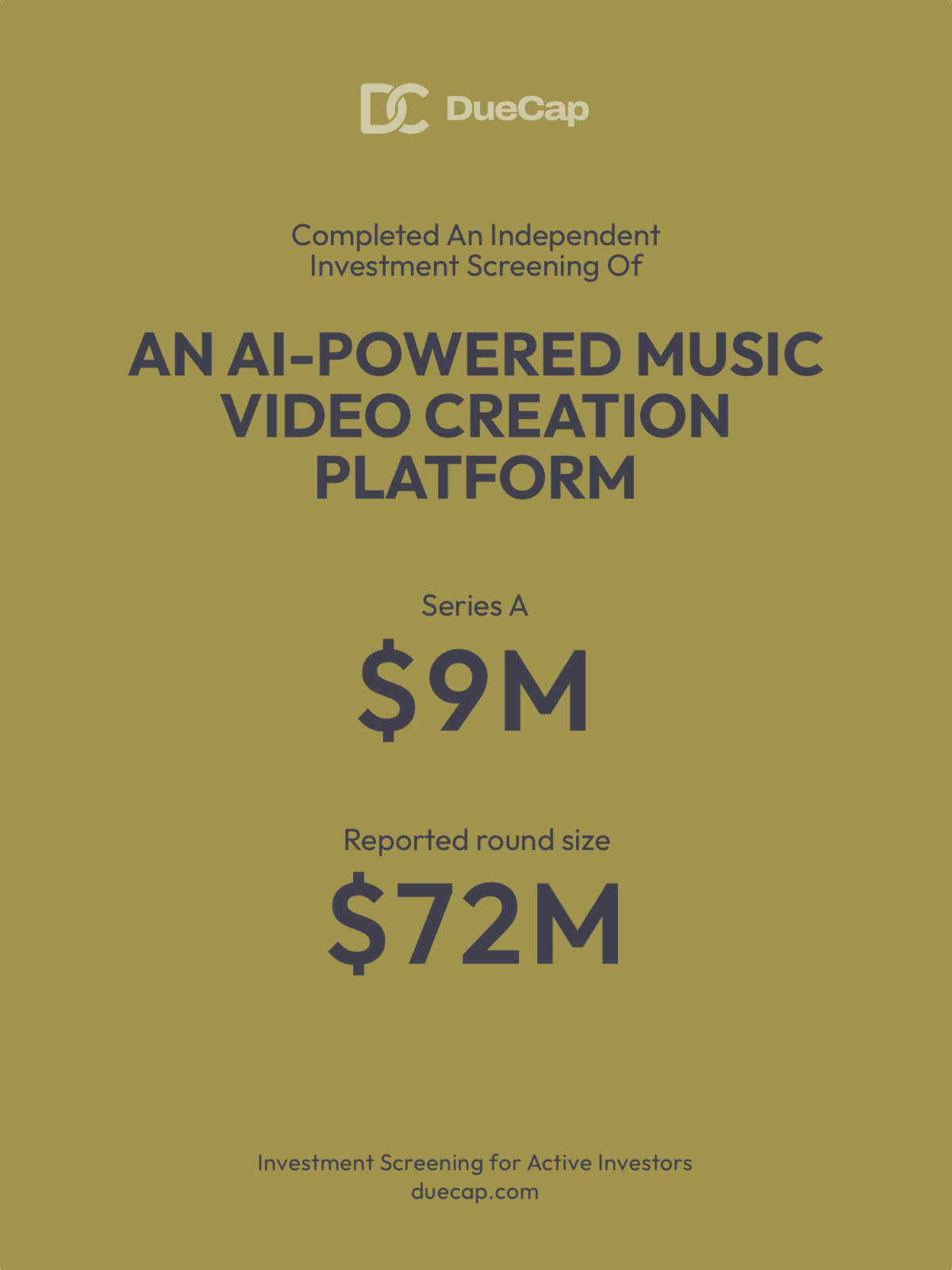
The company reported rapid user and revenue growth, including approximately $469,000 in monthly recurring revenue, more than 16,000 paying customers, and a proposed $9.0 million financing round at a $72.0 million pre-money valuation.

The Screening Objective

The investor needed to determine whether the reported growth, retention, unit economics, legal structure, and transaction terms were sufficiently supported to justify advancing the opportunity.

DueCap reviewed the investment memo, reported operating metrics, pricing, growth claims, proposed use of funds, and the available SPV operating agreement.

What DueCap Identified

The company presented a compelling product proposition in a fast-growing category and reported meaningful user adoption. However, several of the core operating figures did not reconcile when tested against one another.

Reported customer conversion, average plan pricing, paid-customer count, and monthly recurring revenue appeared inconsistent without additional definitions. At the same time, the reported 28.90% monthly churn raised a fundamental question about whether rapid customer acquisition was masking weak retention and repeat value.

The review also found that gross margin, compute costs, cash position, burn rate, runway, capitalization, and detailed use of funds were absent. In addition, the legal identity named in the investment memo differed from the entity referenced in the SPV agreement, while the available transaction documents did not include the complete governing package.

What DueCap Delivered

  • Tested the consistency of the reported operating and revenue metrics.
  • Identified retention and gross-margin evidence as central to the investment case.
  • Reviewed the relationship between the reported valuation and unverified ARR.
  • Flagged unresolved legal-entity and ownership questions.
  • Assessed the visible SPV fees, carry, control provisions, and missing documents.
  • Defined the minimum evidence package required for the next decision.

Screening Outcome

Targeted operating, financial, legal, and transaction information was recommended before scheduling the founder conversation.

The screening shifted the investor’s attention from headline growth toward the quality and durability of revenue, the economics of AI video generation, the identity of the entity receiving the investment, and the investor’s actual net exposure through the SPV.

AI-Powered Hiring Platform for Frontline Organizations

DueCap completed an independent investment screening of a company developing an AI-enabled hiring and workforce platform for frontline organizations.

The company positioned its applicant tracking system as the initial product, with additional modules designed to connect hiring, scheduling, workforce planning, and employee retention.

The Screening Objective

The investor needed to understand whether the company’s customer traction, reported business outcomes, product maturity, and expansion strategy were sufficiently supported to justify advancing the opportunity.

What DueCap Identified

The company addressed a recognizable problem in frontline hiring and presented a logical path from an applicant tracking product into broader workforce-planning and retention capabilities.

However, the submitted materials did not provide enough evidence to determine the commercial reality behind the headline claims. Customer logos were not accompanied by contracts, revenue data, deployment status, or renewal history.

What DueCap Delivered

  • Separated current operating evidence from product vision and roadmap.
  • Identified the customer and financial claims requiring verification.
  • Reviewed pricing, forecast, and use-of-funds consistency.
  • Defined the minimum evidence package needed for the next decision.
  • Prepared an evidence-led agenda for the founder conversation.

Screening Outcome

Additional customer, product, financial, and financing evidence was recommended before advancing the investment review.

This case is based on a completed DueCap engagement. Company identity and selected transaction details have been withheld or generalized to preserve confidentiality.

AI Styling Platform for Fashion Commerce

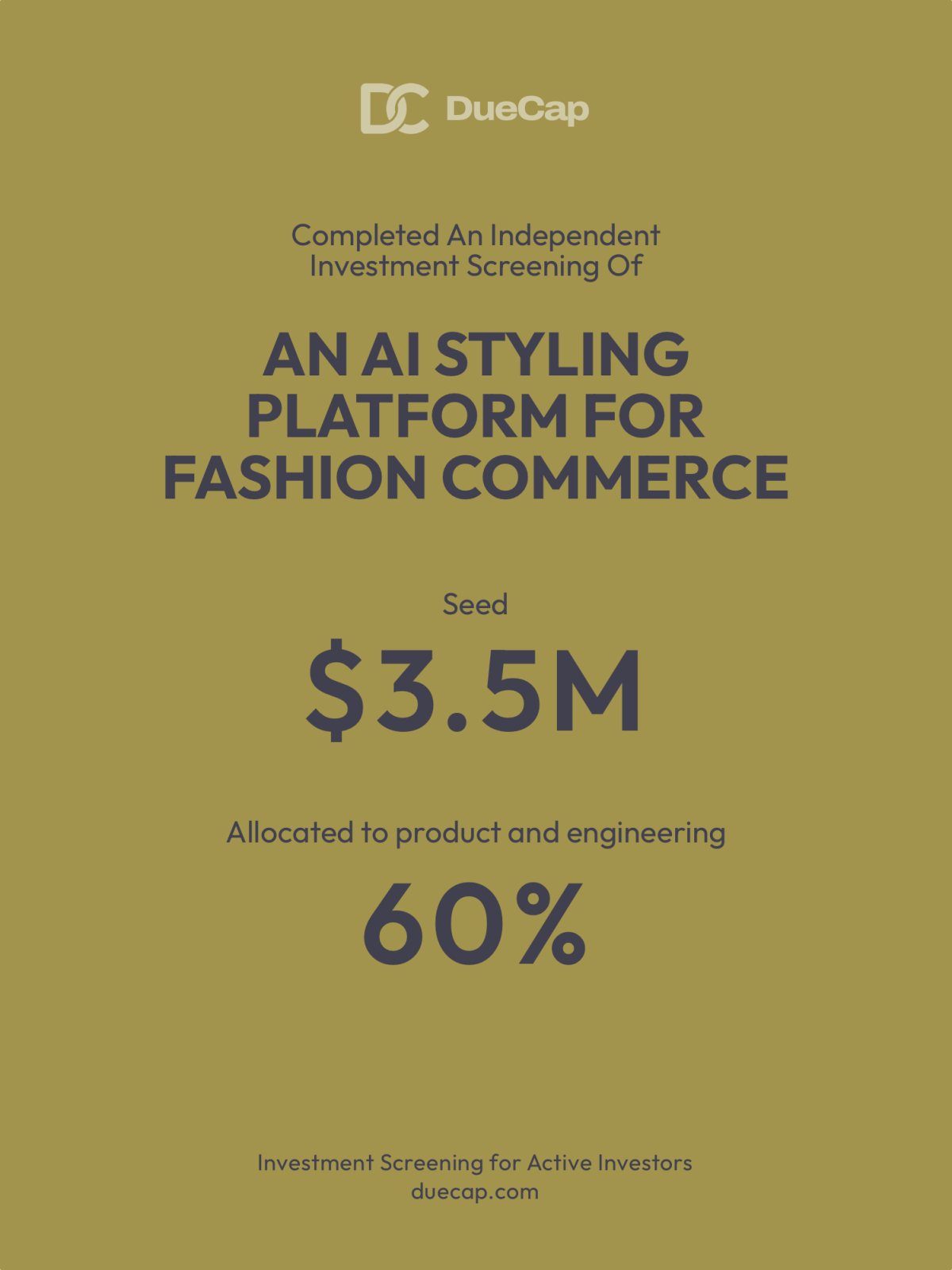
DueCap completed an independent screening of a Seed-stage company developing an AI styling layer for fashion retailers. The product was designed to turn interest in an individual product into a complete, shoppable look, with the intended goals of increasing basket size, improving conversion, and capturing richer customer-intent data.

The company was raising a reported $3.5 million Seed round and referenced a private beta involving four retailers. DueCap reviewed the pitch deck, product and commercial thesis, retailer-validation claims, proposed differentiation, go-to-market model, financing ask, and intended use of funds.

What the Screening Identified

The product addressed a clear point in the online purchasing journey and presented a plausible source of value for fashion retailers. However, the core investment case still depended on validation that was not included in the submitted materials.

The four retailer relationships were not documented, no pilot results were provided, and the package did not define pricing, contracts, implementation costs, sales cycle, or unit economics. The claimed technology and data advantage was also not supported by product benchmarks, intellectual-property documentation, or clear rights to the stylist knowledge underlying the system.

DueCap Delivered

DueCap prepared an Investment Screening Brief that:

  • separated the commercial thesis from the available evidence;
  • assessed the product, customer, business-model, and financing claims;
  • identified the most important validation gaps;
  • prepared a prioritized information request;
  • and defined the questions that should guide the next investor conversation.

Screening Outcome

Request validation evidence before advancing the opportunity

The concept warranted continued attention, but the submitted deck was not sufficient to establish live retailer adoption, measurable commercial impact, viable unit economics, or the proposed financing terms.

DueCap recommended requesting an accessible product demonstration, documentation for the four retailer relationships, pilot results, pricing and contract terms, financial and runway information, capitalization records, and the proposed Seed terms before scheduling the founder conversation.


This case is based on a completed DueCap engagement. The company identity and selected details have been withheld or generalized to protect confidential information. Company claims were not independently verified by DueCap.

Independent Screening of a Series A AI Software Opportunity

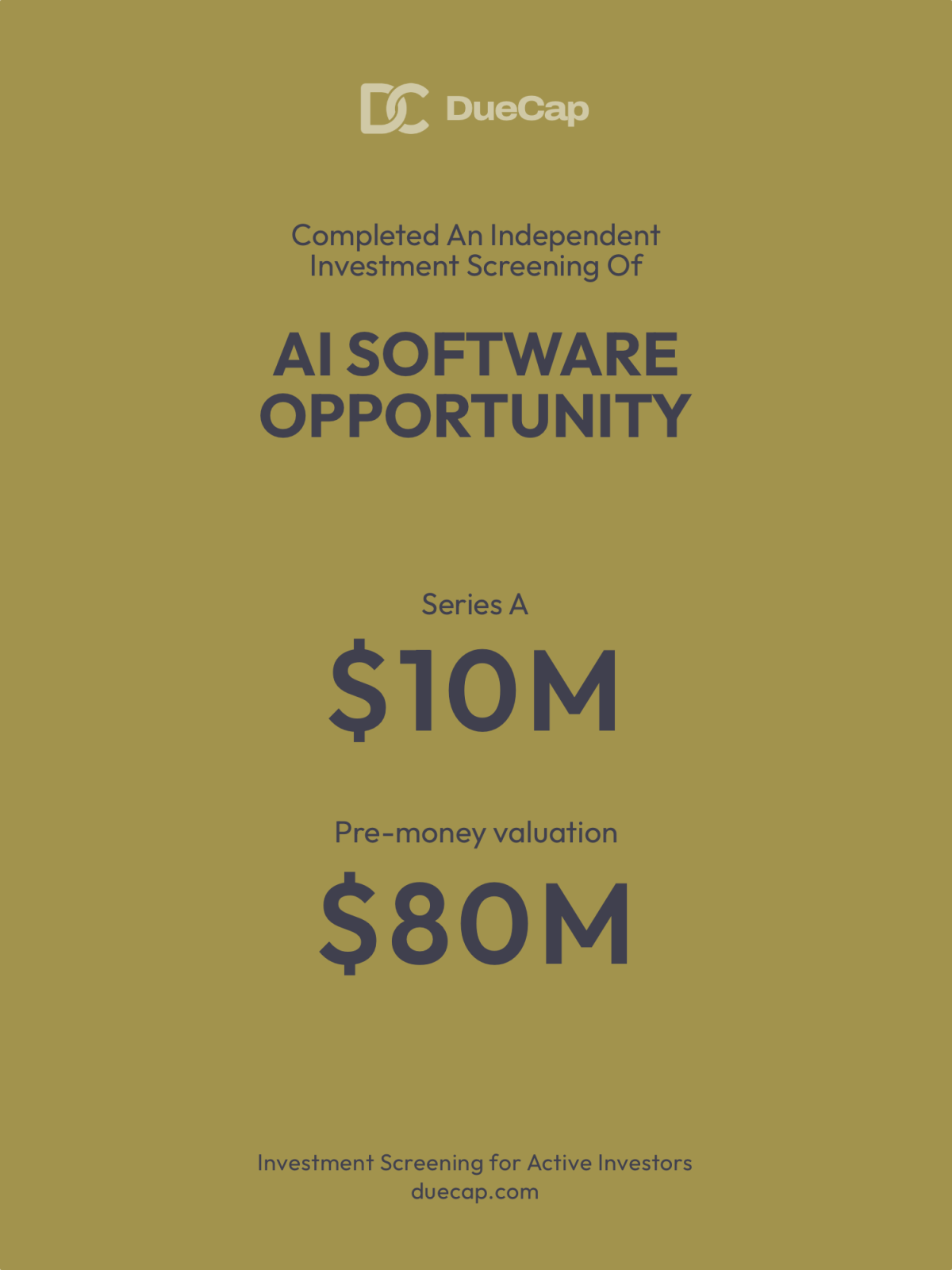
DueCap completed an independent pre-investment screening of an AI-powered music-video creation platform raising a reported $10 million Series A round at an $80 million pre-money valuation.

The company was presented as a fast-growing subscription software business serving musicians, creators, and marketers. According to the submitted investment materials, the platform used an agent-based workflow and multiple generative AI models to produce beat-synchronized music videos, lyric videos, dance content, and short-form social media assets.

The opportunity showed enough reported traction to warrant continued attention. At the same time, the available package did not provide sufficient primary evidence to assess the durability of growth, the quality of recurring revenue, the company’s financial position, or the full economics of the proposed investment.

Engagement

DueCap was engaged to prepare the investor for the next screening decision before a founder conversation.

The review covered the investment memorandum, the available SPV operating agreement, reported operating and financial metrics, the legal identity of the investment target, and the economic terms visible in the supplied documents.

The purpose was not to issue an investment recommendation or perform full due diligence. It was to determine what could reasonably be concluded from the package, identify inconsistencies and material evidence gaps, and establish what should be requested before the investor committed further time or capital.

Opportunity Snapshot

Stage
Series A

Sector
Generative AI / Creator Software

Reported round size
$10 million

Reported pre-money valuation
$80 million

Reported MRR
Approximately $502,800

Reported ARR
Approximately $6.0 million

Reported monthly churn
30.66%

Materials reviewed
Third-party investment memorandum and SPV operating agreement

All company operating figures were treated as reported and unverified because the review package did not include company-prepared financial statements, billing exports, cohort schedules, a capitalization table, or financing documents.

What DueCap Found

Strong reported growth, but unresolved retention quality

The investment memorandum reported substantial user growth, paying customers, recurring revenue, and rapid ARR expansion. However, the same materials also reported monthly churn of 30.66% without defining the calculation or providing customer and revenue cohorts.

This created a central screening question: whether the reported growth reflected durable recurring adoption or a high-volume acquisition funnel continually replacing departing customers. Without cohort retention, gross and net revenue retention, plan mix, cancellation data, and reactivation treatment, the quality of the reported ARR could not be assessed.

Core operating metrics did not reconcile

Several headline metrics did not align on a first-pass arithmetic review.

The reported 17,650 paying customers represented approximately 2.61% of the reported 677,499 users, rather than the stated 5.56% conversion rate. Reported MRR divided by paying customers produced approximately $28.49 per customer, above both the stated average plan price and the highest listed monthly plan. The annual subscription discounts also appeared to be approximately 30%, rather than the stated 50%.

These inconsistencies did not establish that the metrics were incorrect, but they showed that definitions, cohorts, revenue composition, and source schedules were needed before the numbers could be relied upon.

Gross margin and compute economics were not visible

The platform appeared to rely on several external video-generation models while also identifying compute optimization and API scaling as uses of the new capital.

Despite this cost profile, the materials contained no company-prepared gross-margin data, compute or API expenses, vendor invoices, contribution margin, refund economics, or generation-level unit costs.

As a result, DueCap could not determine whether increasing product usage strengthened the economics of the business or increased its capital requirements.

The legal identity of the investment target required confirmation

The investment memorandum described the business using its brand name and referred to a Delaware corporation. The SPV agreement, however, identified a differently named corporation as the investment target.

The relationship between the brand, the operating company, and the named legal entity was not documented in the submitted package. This made it necessary to confirm which entity owned the product, intellectual property, customer contracts, data, and revenue, and which security the SPV intended to purchase.

The SPV package was incomplete

The supplied SPV agreement referenced additional governing documents that were not included in the review.

The visible terms included a multi-year management-fee schedule, a separate SPV fee, 20% carried interest, manager control provisions, indemnification language, and transfer restrictions. Without the complete agreement set and an investor-specific gross-to-net schedule, the actual amount of investor capital reaching the underlying company could not be determined conclusively.

What DueCap Delivered

DueCap prepared a structured Investment Screening Brief that included:

  • an executive screening outcome;
  • an independent summary of the opportunity;
  • financial consistency checks;
  • review of the visible round and SPV economics;
  • assessment of key business and financial signals;
  • identification of legal, operational, and transaction risks;
  • a prioritized evidence request;
  • and a set of questions for the next investor conversation.

The work converted a promotional investment package into a decision-oriented screening document focused on evidence, unresolved assumptions, and the investor’s next practical step.

Screening Outcome

Request targeted evidence before scheduling the founder conversation

DueCap concluded that the reported traction supported continued investor attention, but the package was not sufficient to validate operating performance, retention quality, unit economics, financial position, legal identity, capitalization, or complete SPV terms.

The recommended next step was therefore not to reject the opportunity and not to proceed directly to an investment decision. It was to request a defined evidence package first.

The priority request covered company-prepared financial statements, monthly revenue and customer schedules, retention cohorts, compute and gross-margin economics, cash and runway, current and pro forma capitalization, legal-entity confirmation, financing documents, and the complete SPV agreement set.

Why This Screening Was Valuable

The submitted materials presented an attractive headline narrative: rapid AI adoption, strong reported recurring-revenue growth, a large creator market, and a significant Series A financing.

DueCap’s screening showed that the investment decision depended on a different set of questions. The critical issues were not the size of the reported user base or the speed of ARR growth alone, but whether customers remained, whether revenue carried attractive margins, whether reported metrics used consistent definitions, whether the correct legal entity held the assets, and how much investor capital would actually reach the underlying company.

By identifying those issues before the founder conversation, the investor could enter the next stage with a focused evidence request rather than relying on the narrative of the investment memorandum.


Confidentiality notice

This case is based on a completed DueCap engagement. The company identity and selected transaction details may be withheld or generalized to protect confidential information. Reported company figures were not independently verified by DueCap.
DueCap Prepared an Investment Screening Brief for a Private Startup Investment Opportunity

Overview of the Engagement

DueCap was engaged to conduct an initial review of a proposed investment in a privately held U.S. startup through a dedicated investment vehicle.

The submitted package consisted of one signed 12-page agreement governing the investment vehicle. The document provided information about the vehicle’s structure, management authority, fees, distribution waterfall, tax-allocation mechanics, transfer restrictions, and indemnification provisions.

However, the package contained almost no supporting evidence about the underlying startup. It did not provide a pitch deck, financial statements, operating metrics, capitalization table, investment instrument, valuation, ownership calculation, customer evidence, or information about the company’s product, market, team, and commercial performance.

Key Findings

DueCap found that the submitted agreement was sufficient to begin reviewing the structure and economics of the investment vehicle, but not sufficient to assess the underlying startup or the proposed investment terms.

The review identified several issues requiring clarification before the investor could conduct a productive substantive conversation. These included an incomplete governing-document package, undisclosed investment terms, an unknown gross-to-net funds flow, broad manager authority, and the absence of operating and financial evidence from the underlying company.

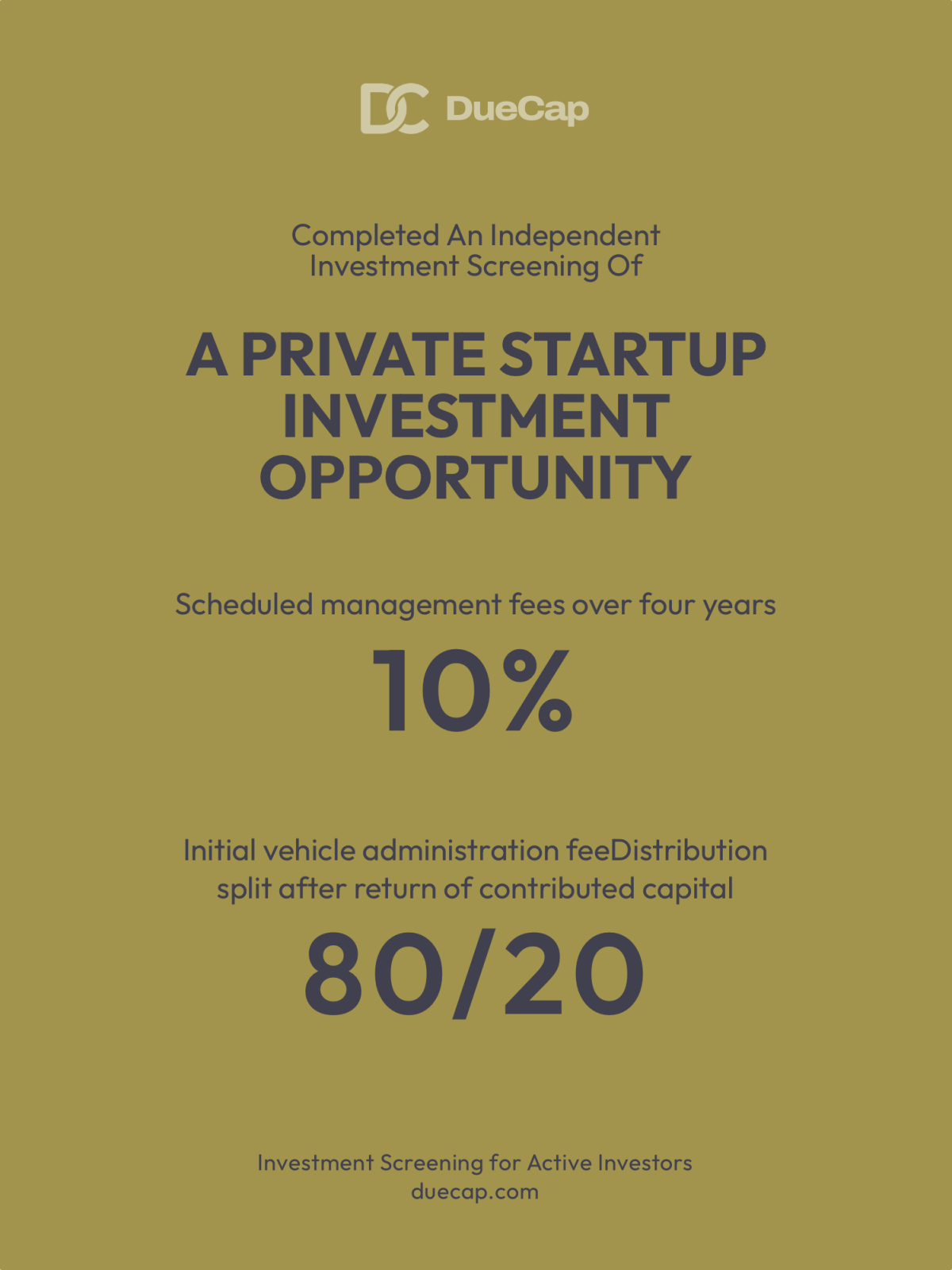
The stated management-fee schedule amounted to 10% of aggregate capital contributions over four years, assuming the same contribution base applied throughout the period. The agreement also stated a fixed vehicle administration fee of $9,500 for the initial four-year period, increasing to $11,000 if the vehicle remained active beyond four years. The review further established that fees and expenses could reduce the amount of investor capital ultimately deployed into the underlying company, but the actual net investment amount could not be calculated from the submitted materials.

The agreement described a distribution waterfall under which investors would first receive a return of contributed capital, followed by an 80/20 split between investors and the manager. No preferred return or hurdle was stated in the reviewed agreement, although DueCap noted that additional governing documents could contain relevant terms.

Screening Outcome

DueCap concluded that the opportunity was not ready for a substantive founder or sponsor conversation based on the available package.

Rather than filling the missing information with assumptions, DueCap prepared a prioritized evidence request and 15 questions covering the underlying business, investment security, valuation, capitalization, vehicle governance, fees, funds flow, financial condition, and investor rights.

The recommended next step was to request the missing governing documents, transaction materials, capitalization records, operating information, and financial evidence before continuing the investment review.

DueCap’s Role

DueCap reviewed the submitted investment documentation and converted it into a structured Investment Screening Brief for the investor.

The Brief distinguished confirmed facts from assumptions, calculated the economics that could be supported by the available documents, identified the information preventing further assessment, and prepared the investor for a more focused follow-up with the sponsor and company.

DueCap did not make an investment recommendation or provide legal or tax advice. The purpose of the engagement was to establish what was known, what remained unresolved, and what evidence was required before the opportunity could be evaluated further.

Company, investor, sponsor, and vehicle details have been withheld. Certain descriptive details have been generalized to preserve confidentiality.