

INVESTMENT SCREENING BRIEF
A decision-ready view of the opportunity before deeper diligence.
The Investment Screening Brief is DueCap's core screening deliverable: a concise, evidence-based view of what the materials support, what remains unresolved, and what deserves attention next.
Part of DueCap's Investment Screening & Decision Support service
WHAT THE BRIEF IS FOR
Not a summary of the startup story. A structured challenge to the investment case.
The Brief turns scattered company materials into a working decision document. It is designed to help an investor understand the opportunity faster, identify what has not yet been proven, and prepare for the next step without turning an early review into full diligence.
A SCREENING INSTRUMENT
The Brief is the first structured output of DueCap's external investment team model.
It creates a common view of the opportunity before more senior time, specialist diligence, or capital is committed.
The point is not to replace investor judgment. It is to make that judgment easier to apply to the evidence that actually matters.
01
See the opportunity in one view
Bring the business, financials, signals, gaps, and key open questions into a single working document.
02
Separate claims from evidence
Distinguish what the company says from what the available materials actually support.
03
Expose what remains unresolved
Surface inconsistencies, assumptions, missing information, and issues that could materially affect the case.
04
Prepare the next decision
Clarify whether to stop, request more evidence, meet the founder, or move toward deeper diligence.
INSIDE THE BRIEF
A concise structure built around the questions an investor needs to answer next.
The exact depth varies with the opportunity and the materials available. A typical Investment Screening Brief brings together six core views.
01 · EXECUTIVE SNAPSHOT
The opportunity at a glance
What the company does, the financing context, current traction, and the few issues most likely to shape the next decision.
02 · BUSINESS OVERVIEW
How the business is supposed to work
Customer, value proposition, revenue model, product, go-to-market logic, and the commercial assumptions behind the story.
03 · FINANCIAL SNAPSHOT
What the numbers actually show
Revenue, growth, burn, margins, runway, financing needs, and material inconsistencies across available financial information.
04 · KEY BUSINESS SIGNALS
Evidence beyond the narrative
Traction, customers, market logic, execution dependencies, operating signals, and claims that deserve closer examination.
05 · KEY FINANCIAL SIGNALS
Where economics supports or weakens the case
Quality of revenue, pricing logic, cost structure, unit economics, capital efficiency, and the assumptions carrying the forecast.
06 · MISSING INFORMATION
What still needs to be proven
Documents, metrics, evidence, explanations, and management responses are required before the investor can move forward with confidence.
THE FULL SCREENING PACKAGE
The Brief is useful because it connects analysis to the next investor conversation.
Every screening engagement can produce three connected outputs. The Brief organizes the evidence; the other two turn unresolved issues into action.
CORE DELIVERABLE
Investment Screening Brief
A concise, evidence-based view of the opportunity, the business and financial signals, the inconsistencies, and the information still missing.
DECISION PREPARATION
Questions Before Investing
A prioritized set of questions arising from the evidence, unsupported assumptions, contradictions, and information gaps identified during the review.
FOUNDER CONVERSATION
Founder Interview Guide
A structured agenda that turns those questions into a focused management conversation and helps the investor probe the areas that matter most.
DueCap can work inside the investor's existing workflow and systems. The service is the operating responsibility and judgment layer around the pipeline - not a requirement to adopt another software stack.
WHERE THE BRIEF FITS
A bridge between an incoming opportunity and the decision to go deeper.
The Investment Screening Brief is not intended to replace full diligence. Its role is to make the decision about deeper diligence more informed.
01
Opportunity arrives
Deck, financials, and supporting materials enter the investor's workflow.
02
Initial screening
DueCap reviews the case, evidence, inconsistencies, and missing information.
03
Screening Brief
The open issues become a more focused set of questions and evidence requests.
04
Founder conversation
The open issues become a more focused set of questions and evidence requests.
05
Next decision
Stop, request more information, or commit resources to deeper diligence.
WHAT IT IS - AND WHAT IT IS NOT
The Brief improves the basis for judgment. It does not make the investment decision.
The Brief Is
The Brief is Not
SAMPLE VIEW
Designed to be read quickly, challenged easily, and used in the next conversation.
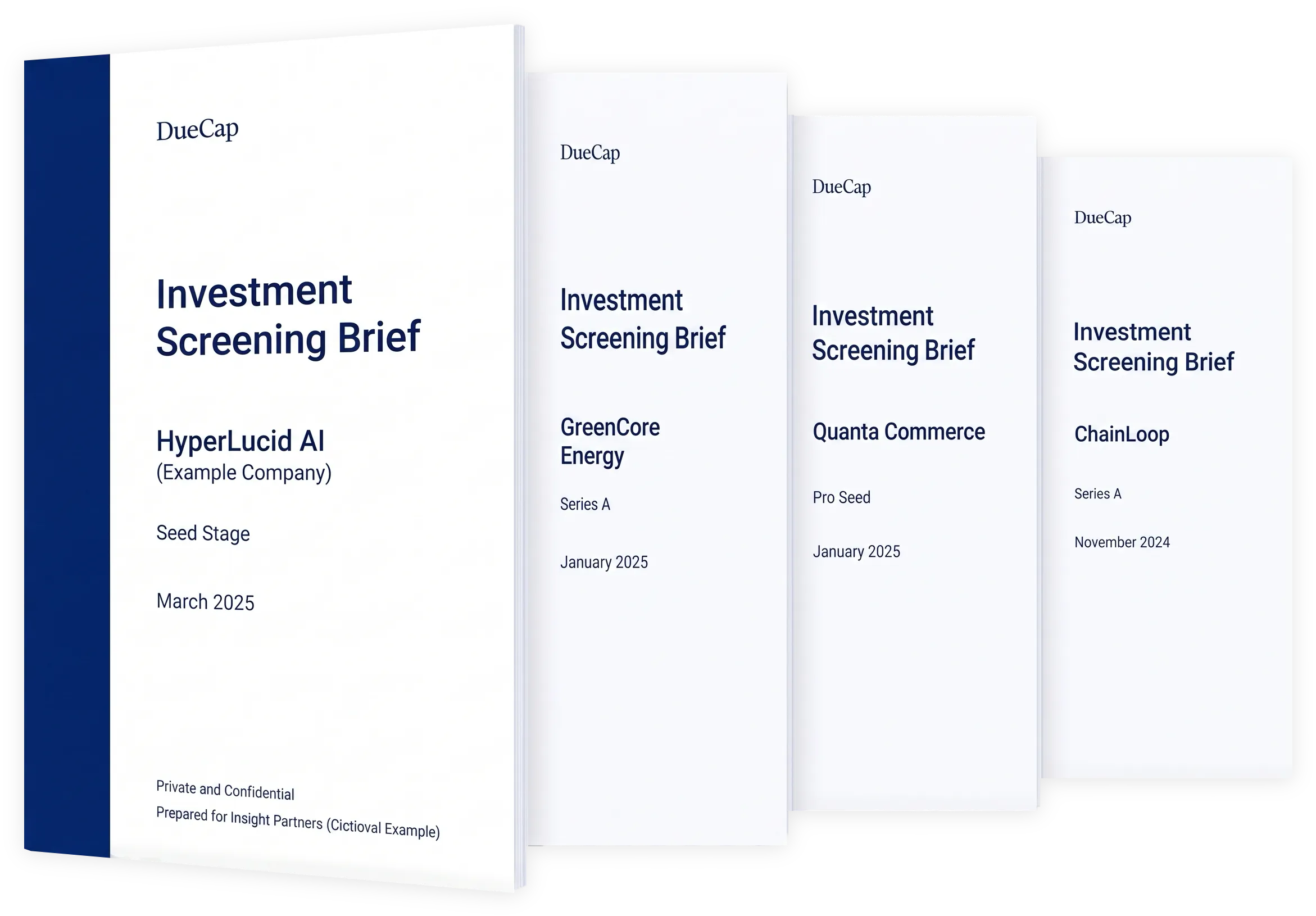
A working document, not a polished narrative.
The Brief is meant to make the investment case easier to interrogate. It should help the investor move from “I understand the pitch” to “I know what I still need to understand.”
Start with one opportunity.
There is no need to adopt a broad outsourced model upfront. Send a live deal and evaluate the quality of the work first. If the relationship proves useful, we can discuss what else should be delegated.
DueCap
Clarity before capital: External investment team for lean investors.
© 2026 DueCap. DueCap is a Solten Ventures company.
Services
Resources
Company
Legal